Blackheads or Sebaceous Filaments: Do Those Dots on Your Nose Need Extraction?
November 22, 2026
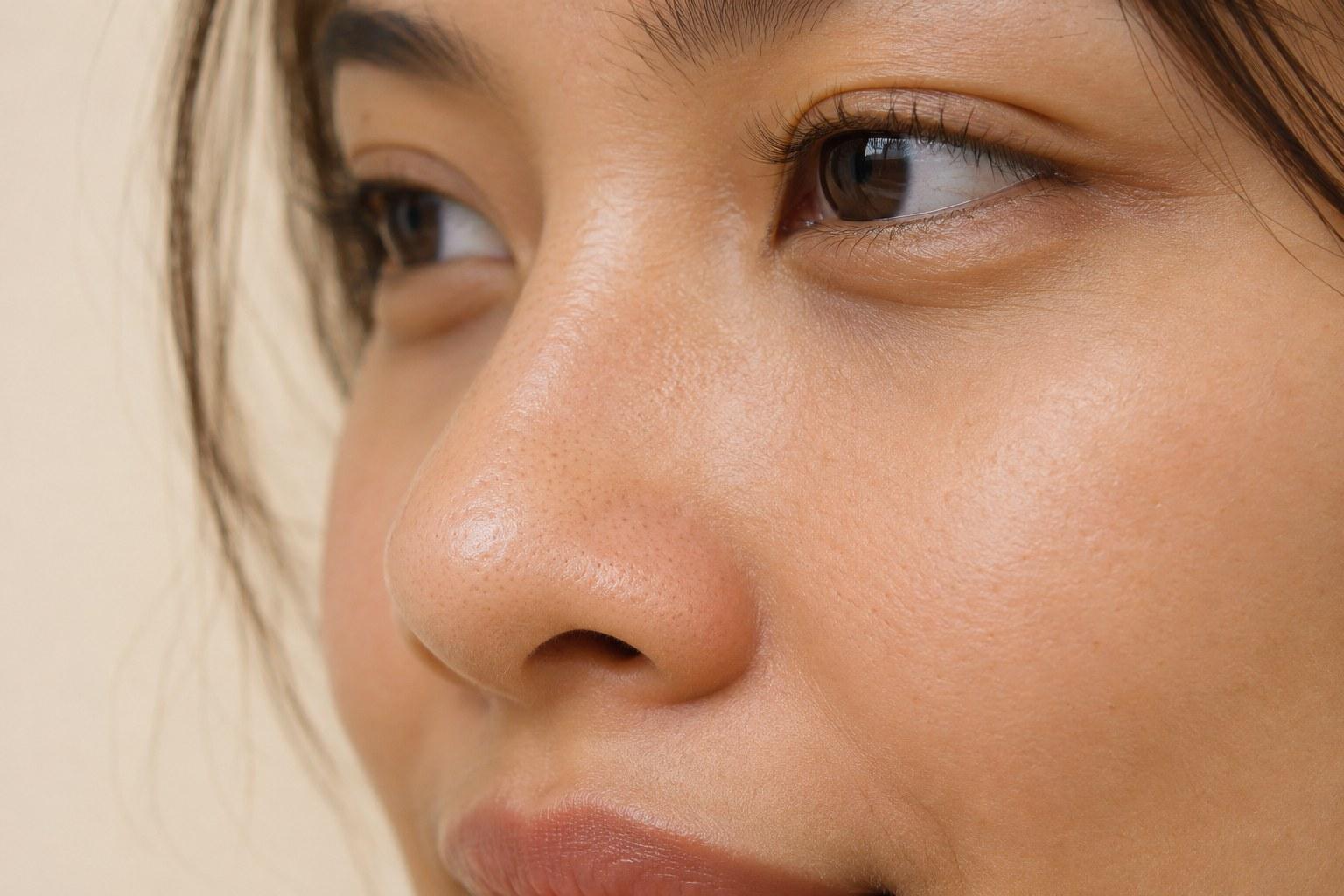
Not necessarily. Tiny dots that return on your nose do not, by themselves, mean you need repeated extraction. Some may be sebaceous filaments: normal material within oil-rich follicles, rather than blackheads. The useful question is not “How do I empty every pore?” but “What am I looking at, and is doing anything to it worthwhile?” Normal-looking, comfortable skin does not have to become dot-free to be well cared for.
What is the difference? Sebaceous filaments contain a mixture of oil and shed skin-cell material around a hair. Cleveland Clinic’s explanation of sebaceous filaments describes their role in helping oil reach the surface and notes that they are a normal feature of skin, not a type of acne. They can appear as small, relatively flat grey, yellowish or light-brown dots. Blackheads are different: the American Academy of Dermatology’s guide to acne signs describes a buildup of oil and dead cells inside a pore with an open surface. Its dark colour comes from a reaction with oxygen, not dirt. These are general descriptions, not a checklist that can identify every dot on your nose.
Why do filaments return after removal? Emptying a follicle does not switch off the process that fills it. In their 1976 microscopy study of sebaceous filaments, Plewig and Wolff described them as a common variation of sebaceous follicles and reported refilling within 30 days after expression. That is an observation from an older study, not a personal countdown or a recommended monthly extraction schedule. It supports a more modest conclusion: removing the visible contents is not permanent removal of the structure. Seeing dots again within weeks is not proof that your cleansing has failed.
Can a photo tell you which kind you have? A phone close-up can show where the concern is, but it cannot reliably settle every look-alike. Even the microscopy study distinguishes filaments from other follicular findings. Do not squeeze a dot to see what comes out as a home identification test. If you are unsure, especially if one spot behaves differently from the surrounding dots, seek an individual assessment rather than matching it to a social-media image. Our guide to comparing skin photos and lighting explains another reason to be cautious about judging a result from a magnified picture.
What about squeezing and pore strips? Cleveland Clinic advises against squeezing sebaceous filaments and cautions that strips can remove them as well as blackheads. Material on a strip is therefore not evidence that everything removed needed to go. For acne blemishes, the AAD’s advice on home squeezing warns about inflammation, infection and scarring. Repeating the process more forcefully because the dots returned is not a better maintenance plan. Leave a sore or irritated area alone rather than following a strip with a scrub or another attempt to empty it.
What is a reasonable home approach? Start with gentle cleansing rather than a nose-only deep-cleaning ritual. The AAD’s guidance on visible pores recommends gentle care and non-comedogenic products, and warns against scrubbing, picking and squeezing. Do not add several exfoliants just because one close-up looks textured. If products make your skin sting or feel persistently uncomfortable, simplify and get advice. Our visible-pores guide covers the broader goal of making pores less noticeable without promising to erase them.
Where does a facial fit? If you are considering Clear-Matt Treatment, ask about your actual concern rather than booking on the assumption that every dot needs extracting. d’reena’s menu lists this as a 60-minute service with a soft peel and dermal layering; it also lists GlowFix solution and extraction. That does not establish that extraction is appropriate for every dot or every visit, or that the treatment permanently removes sebaceous filaments. Useful questions are: “What would you leave alone?”, “What change in appearance is realistic?” and “What should I avoid doing at home afterwards?” Medical acne extraction and a cosmetic facial are not interchangeable services.
When should you seek medical advice? Painful, repeatedly inflamed, bleeding or changing spots should not be treated as an ordinary pore-cleaning project. If the cause is unclear or the problem persists, ask a doctor rather than repeatedly extracting it. d’reena is a beauty house, not a medical provider, and does not diagnose skin lesions. For cosmetic routine guidance, start with our Skin Analysis. The aim is a comfortable, manageable routine—not a promise that a normal nose will stay poreless. The hero is an AI-generated editorial illustration, not a diagnostic example or a customer result.
Not sure this is right for your skin?
Take our 2-minute Skin Analysis for a personalised recommendation before you book.